How Much Does a White Label Travel Portal Cost in India?
By Flyshop Team | Last updated: 24 November 2026 | Reading time: 12 minutes
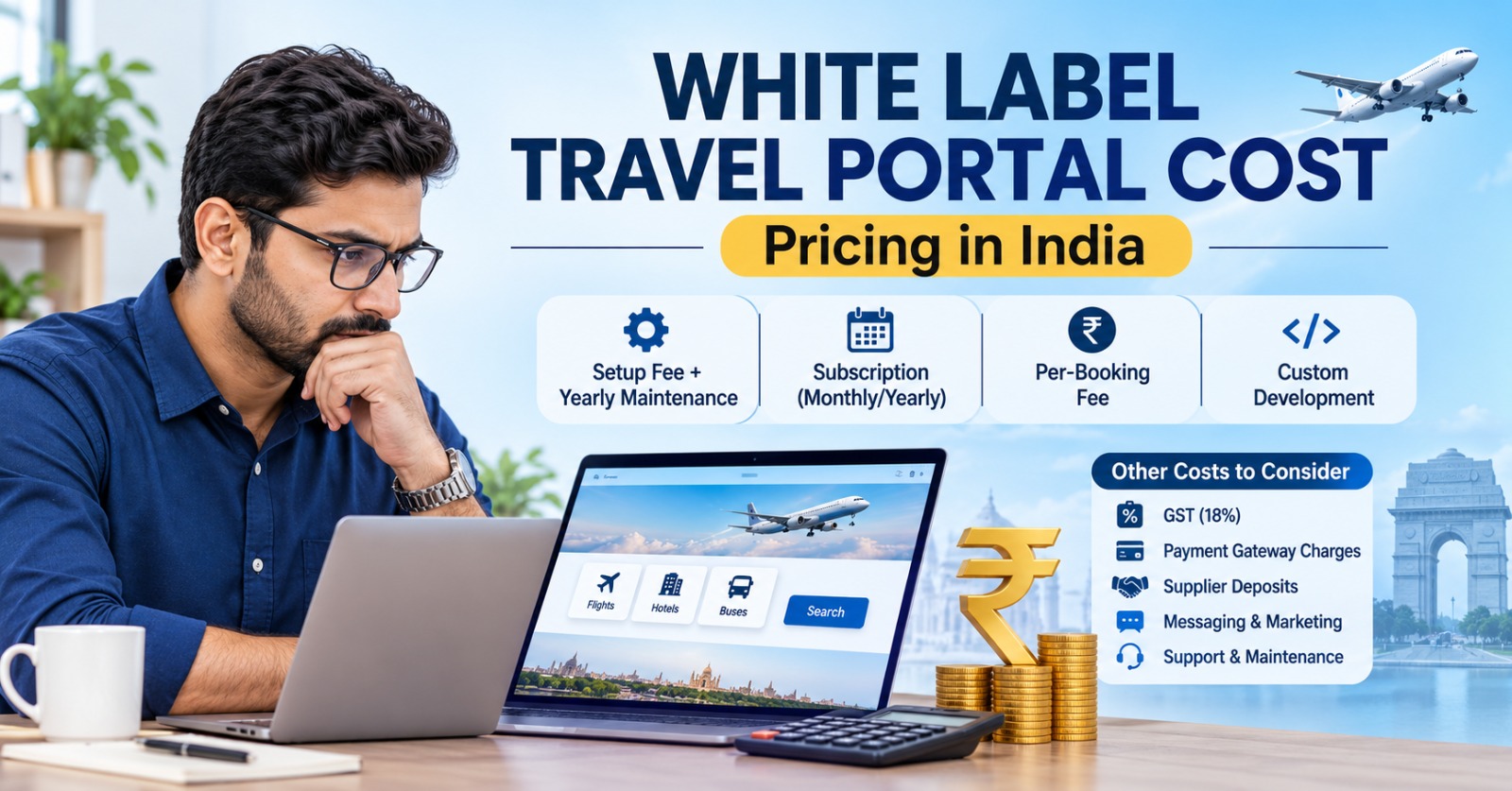
A white label travel portal in India is usually priced as a one-time setup fee plus yearly maintenance, a recurring subscription, or a per-booking fee, and vendors publish very different amounts. Your real cost also includes 18% GST, payment gateway charges and supplier deposits. Compare the three-year total, not the headline price.
If you are comparing a white label travel portal, the first number you see is rarely the number you will pay. One vendor shows a yearly fee, another shows a setup fee, and a third says "contact us". This guide explains what decides the price, how the pricing models differ, which costs sit outside the vendor's quote, and how to compare offers on equal terms. It is written for Indian travel agents, wholesalers and startups, and it avoids guessing: where a price is not public, we say so.
1. What decides the cost of a white label travel portal?
Two businesses can both buy a portal and pay very different amounts, because the price follows what the portal has to do. These are the main drivers:
- Business model. A B2C site for retail travellers is simpler than a B2B portal that needs agent logins, sub-agents, wallets, credit limits and markup rules. A combined B2B and B2C setup covers both.
- Modules. Flights, hotels, buses, cabs, holiday packages and visa each add scope. Start with the products you can actually source.
- Supplier access. The software and the inventory are different things. Portal fees rarely include supplier deposits or commercial terms you must agree yourself, which is why travel API integration deserves its own line in your budget.
- Branding and customisation. Your logo, colours and domain are normally part of a white label product. Custom screens, new workflows or extra reports usually cost more.
- Support and hosting. Ask what is included in the fee and what is billed separately.
- Contract length. Multi-year terms, renewals and price changes can matter more than the first-year quote.
A portal is software; inventory is a separate commercial arrangement. A low portal price tells you nothing about what suppliers will charge or require, so ask for both answers before you compare vendors.
2. Pricing models compared
Public vendor pages for a white label travel portal show a very wide spread, from free plans to several lakh rupees, and many do not say whether an amount is one-time or recurring. That is why the model matters as much as the number.
| Model | How it works | Suits | Watch out for |
|---|---|---|---|
| Setup fee plus yearly maintenance | You pay once to launch and then renew each year. | Agencies that want predictable costs | What maintenance covers, and renewal changes |
| Monthly or yearly subscription | One recurring fee, often tiered by features. | Low upfront budgets | Three-year total, and limits on each tier |
| Per-booking fee or commission | The vendor takes a cut of each sale. | Very low early volumes | Cost rises as you grow; ask for a cap |
| Custom development | A team builds software for you. | Large firms with unique workflows | Highest cost, longer timeline, and you maintain supplier connections |
For most new agencies, the first two models are the practical choice. If you are still deciding whether to buy or build, read our guide on how to choose a white label travel portal for a scorecard you can use in demos.
3. What Flyshop's plans include
Flyshop's plans section offers three plans for its white label travel portal, built around the business model you choose:
| Plan | Model | Notable inclusions |
|---|---|---|
| White Label Basic | B2C | Customer login system and no sub-agent login or wallet |
| White Label Advance | B2B | Sub-agent login, wallet top-up with transaction history and secure agent login |
| Complete White Label | B2B and B2C | Admin control, customer dashboard, complete B2B section, customer and agent login, commission management |
The page lists flight, hotel, bus and cab bookings, holiday packages and visa, markup management, WhatsApp and mail integration, an integrated payment gateway and SEO-friendly pages across the plans. For current pricing and what each fee covers, ask the team through the contact page or book a demo. To see how each plan behaves, review the B2B white label travel portal and the B2C travel website pages, or compare modules on the features page.
4. Costs that sit outside the portal fee
A quote for a white label travel portal is only one line of your budget. Plan for these as well:
- GST. Software and IT services are generally taxed at 18% in India, and the September 2025 GST rate changes left IT services at that rate. Check the GST portal and your accountant.
- Payment gateway charges. Gateways set their own per-transaction fees. The Reserve Bank regulates payment aggregators under a Master Direction issued in September 2025, so confirm your gateway partner is authorised.
- Supplier deposits and wallet float. B2B sellers often fund supplier balances or agent credit before sales arrive.
- Messaging and add-ons. WhatsApp, SMS and email messages, extra domains and paid themes may be billed separately.
- People and marketing. A portal does not sell by itself. Budget for support staff, agent onboarding and promotion.
- Compliance. India's data protection rules were notified in November 2025 with obligations phasing in over roughly 18 months, so allow for privacy notices, consent flows and a legal review.
The Digital Personal Data Protection Rules, 2025 were notified on 14 November 2025 and are being phased in. Read the official summary from the Press Information Bureau and ask your lawyer what applies to the traveller and agent data you will hold.
5. A three-year cost worksheet you can copy
Use the same worksheet for every white label travel portal vendor so quotes can be compared fairly:
- Write down the one-time setup fee, or zero if there is none.
- Add the yearly maintenance or subscription fee for each of three years, including any stated increase at renewal.
- Add paid extras you need: custom work, extra modules, themes and messaging.
- Add 18% GST on the taxable total unless the vendor quotes GST inclusive.
- Add gateway fees and supplier deposits from your own estimates.
- Divide the total by your expected number of bookings to get a cost per booking.
Illustrative example only, not a quote from any vendor: assume a setup fee of Rs 25,000 and yearly maintenance of Rs 12,000. Over three years that is Rs 25,000 plus Rs 36,000, or Rs 61,000. GST at 18% adds Rs 10,980, giving Rs 71,980 before gateway fees, deposits and marketing.
Ask every vendor for a written three-year quote that lists renewals separately. A cheaper first year can cost more overall if maintenance rises later.
6. Ten questions to ask before you pay
- What exactly does the setup fee cover, and is there one?
- What does yearly maintenance include, and what happens at renewal?
- Are API usage charges, deposits or minimum commitments involved?
- Which payment gateways work, and who sets the fees?
- Is GST included in the quote?
- Can I use my own domain and brand, and who owns the domain?
- Who owns customer and booking data, and can I export it?
- What support is included, and through which channels?
- How do I upgrade, downgrade or leave, and what does that cost?
- What is the three-year total including renewals, GST and paid add-ons?
Never rely on a verbal promise. Get setup scope, renewal terms, supplier requirements and exit terms in writing before you pay anything.
7. Mistakes to avoid when budgeting
- Comparing first-year prices only. Compare the full three-year total.
- Treating the white label travel portal as the whole budget. Suppliers, gateways, staff and marketing add real cost.
- Buying B2B features for a retail business. Wallets and sub-agent hierarchies are wasted if you only sell to travellers.
- Ignoring exit terms. Leaving a vendor is hard if you do not control your domain and data.
- Choosing on price alone. A weak back office or slow support costs more in lost bookings than a few thousand rupees saved.
8. When a white label travel portal is not the right buy
Be honest about fit. If you have no supplier access and no customers yet, spend your first effort on suppliers and demand, because software alone will not create sales. If you need a workflow no standard product supports, custom development may be justified. And if you sell a handful of bookings a month, a simple enquiry website may be enough until volumes grow. Our guide on building a B2B travel website covers the other steps around the software.
9. Frequently asked questions
Is there a free white label travel portal?
Some vendors advertise a free plan, but free usually means limited features, branding or support. Before relying on one, ask what is excluded, whether bookings are capped, who owns the customer data, and what the paid upgrade costs. A white label travel portal that cannot run your real workflow is not free in practice.
Can I pay monthly instead of yearly?
It depends on the vendor. Some price by the year, some by the month, and some take a fee per booking. Whatever the schedule, ask for the total across three years including renewals, so a low monthly number does not hide a higher overall cost. Ask Flyshop's team about payment terms for your chosen plan.
Does the price include flight, hotel and bus inventory?
Not automatically. The portal fee covers software, while inventory comes from suppliers connected to your account, and available services depend on those connections. Ask which suppliers are already live, what you must contract yourself, and whether any deposits or minimum commitments apply before you start selling.
Do I pay GST on a white label travel portal?
Software and IT services are generally taxed at 18% GST in India, so expect GST on top of the quoted amount unless the vendor states it is inclusive. If your business is GST-registered you can usually claim input tax credit on business purchases. Confirm the treatment with your chartered accountant.
How long will it take to recover the cost?
There is no honest universal figure. Divide your three-year total cost by your average margin per booking to see how many bookings you need to break even, then compare that with realistic monthly sales. If the number looks out of reach, start smaller or build your agent network first.
What happens to my data if I stop paying?
Ask before you sign. Get written answers on who owns customer and booking records, whether you can export them, how long the vendor keeps them, and whether your domain stays with you. Under India's data protection law you may also carry obligations for personal data you collect, so keep a copy of your policies.
Can I start with B2C and add B2B later?
Many businesses do. Flyshop lists separate B2C and B2B plans as well as a combined plan on its plans section. Ask the team whether switching plans keeps your branding, domain and data, and what the upgrade costs, so you are not forced into a rebuild when your agent network grows.
Seeing the agent login, wallet and markup screens tells you more than any price list. Book a free demo, message us on WhatsApp at +91 92185 01850, or write to support@flyshop.in. You can also read our overview of the white label travel portal product, the explainer on what it is and how it works, and the travel API guide for Indian agents to plan the supplier side of your costs.
This article is general information for travel businesses and is not tax, legal or financial advice. Confirm GST, licensing and data-protection requirements with a qualified professional.