Case Study: How Karan, a Travel Agent from Lucknow, Takes a Smarter Approach to Ads with Flyshop.in
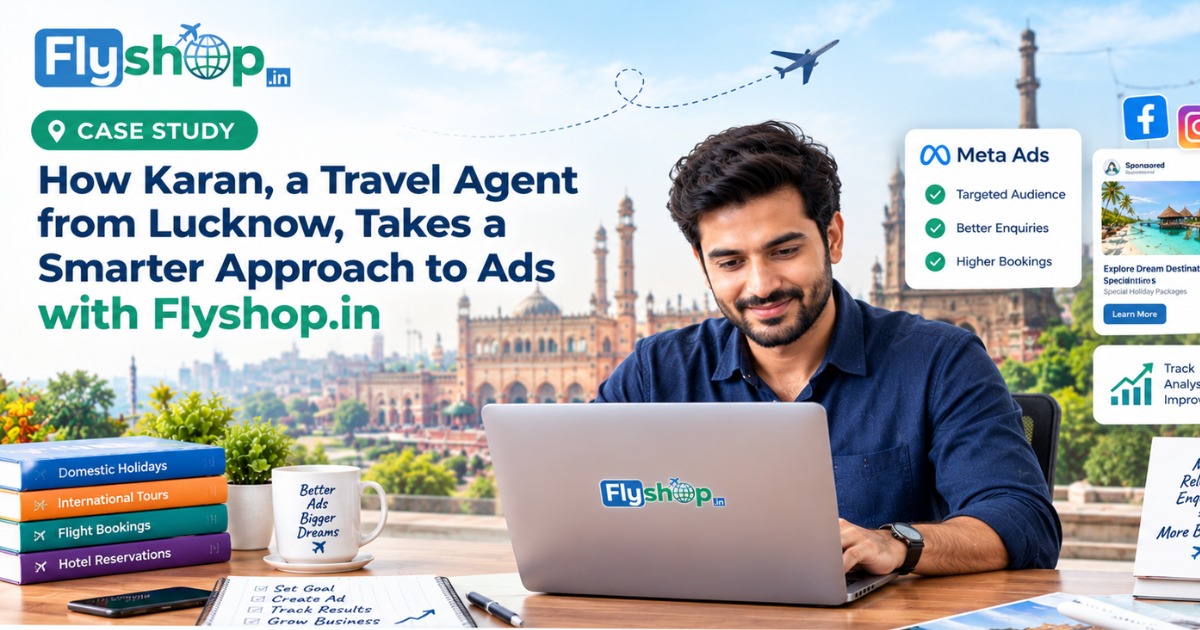
Meet Karan, a Travel Agent from Lucknow
Online advertising can help travel agents reach people who are actively exploring holiday packages, flight bookings, hotel reservations, and other travel services. However, running advertisements is only one part of a successful marketing strategy. Understanding which campaigns generate relevant enquiries is equally important.
Meet Karan, a travel agent from Lucknow who promotes his travel services online. Like many travel business owners, Karan wants to attract more potential customers and grow his business through digital marketing. But he also recognizes an important challenge: not every click, like, or enquiry translates into a genuine booking opportunity.
Some people may click an advertisement out of curiosity, while others may enquire about services that do not match what he is promoting. Without reviewing the quality of these enquiries, it can be difficult to determine whether a campaign is reaching the right audience.
Karan decides to take a more structured approach to online advertising. Instead of focusing only on campaign activity, he begins setting clear goals, promoting specific services, reviewing incoming enquiries, and using the information to improve future campaigns.
With the help of available marketing tools and an organized process, Karan works towards making more informed advertising decisions.
The Challenge: Understanding What Makes an Ad Campaign Useful
For travel agents, online advertising can involve promoting several services, including domestic holiday packages, international tours, hotel bookings, flight reservations, and customized travel plans.
While promoting multiple services may seem like a good way to reach more customers, it can make campaign performance harder to evaluate when every advertisement has a different objective.
For example, an advertisement promoting an affordable domestic holiday package may attract customers looking for budget-friendly trips. Another advertisement promoting international holidays may attract people with different budgets, travel preferences, and booking timelines.
If Karan evaluates both campaigns using only clicks or engagement, he may overlook the differences in enquiry quality.
He identifies three important challenges:
- Unclear campaign objectives: Without a specific goal, it becomes difficult to decide what success should look like.
- Uncertain enquiry quality: Not every person who responds to an advertisement is necessarily a suitable potential customer.
- Limited learning from previous campaigns: If campaign results are not reviewed systematically, the same messaging or targeting mistakes may continue.
Karan understands that better advertising decisions require more than launching campaigns and waiting for enquiries. He needs a process that helps him connect his marketing activities with meaningful business outcomes.
Step 1: Set a Clear Goal for the Campaign
Before launching his next promotion, Karan decides exactly what he wants the advertisement to achieve.
Rather than promoting every travel service at once, he selects one service to focus on. This could be a particular holiday package, a domestic tour, or another service that matches his business priorities and customer demand.
He then defines the purpose of the campaign.
For example, if Karan chooses to promote a holiday package, his objective may be to attract enquiries from travellers who are genuinely interested in that destination and whose budgets and travel dates are reasonably aligned with the offer.
This gives him a clearer basis for evaluating the campaign.
Karan also considers what information he should track. Depending on the campaign objective and available tools, this may include the number of enquiries received, the relevance of those enquiries, the number of customers who continue the conversation, and any bookings that can be reliably attributed to the campaign.
By defining the objective in advance, he can distinguish between activity and actual progress towards his business goals.
A campaign that generates many clicks but very few relevant enquiries may require a different approach from one that generates fewer clicks but attracts customers with genuine booking intent.
The key lesson: Define what success means before spending money on advertising. A clear campaign goal makes it easier to evaluate results and decide what to improve.
Step 2: Launch a Focused Promotion with Meta Ads Automation
After selecting his service and defining his objective, Karan moves to the campaign setup.
He explores Meta Ads automation and the available Flyshop.in tools that can help streamline relevant advertising activities, depending on his setup and the features available to him.
His focus is on keeping the campaign aligned with the service he wants to promote.
First, he develops a clear message explaining the travel offer. The advertisement should communicate what is being promoted and why it may be relevant to the intended audience. Important details should be easy to understand, helping potential customers decide whether the offer matches their needs.
Next, Karan considers the audience he wants to reach. A promotion for a family holiday, for instance, may require a different approach from an offer aimed at couples or travellers looking for international trips.
He also makes sure that the next step for interested customers is clear. Depending on his campaign setup, this could involve visiting his travel website or submitting an enquiry through the designated channel.
Meta Ads automation can support aspects of campaign management, but automation alone does not guarantee better targeting or more bookings. Campaign performance still depends on the offer, creative, audience, budget, customer demand, and follow-up process.
By keeping his promotion focused, Karan creates a more manageable campaign that he can evaluate against his original objective.
The key lesson: A focused advertisement makes it easier to understand which service is being promoted, who it is intended for, and whether the resulting enquiries are relevant.
Step 3: Review Enquiry Quality Instead of Counting Clicks Alone
Once the campaign begins generating responses, Karan shifts his attention to the people behind the numbers.
He reviews the enquiries to determine whether they match the service being promoted.
For example, if his advertisement promotes a particular holiday package, he considers whether the people contacting him are interested in that destination, whether their travel plans are relevant, and whether their requirements are broadly aligned with the offer.
He also pays attention to the conversations that follow an initial enquiry.
Some customers may ask for package details and continue discussing their plans. Others may discover that the offer does not match their budget or preferred travel dates. Some may enquire without having any immediate intention to book.
These differences matter because the total number of enquiries does not tell Karan everything he needs to know about campaign performance.
He can organize enquiries according to useful stages, such as new enquiry, relevant prospect, follow-up required, and booking confirmed, where his workflow supports these categories.
This helps him identify where potential customers are progressing and where conversations are stopping.
Karan also recognizes that he needs reliable tracking to understand the relationship between advertising and business results. Where practical, he records which campaign generated an enquiry and whether that enquiry eventually led to a booking.
The key lesson: The value of an advertising campaign should not be judged by clicks alone. Relevant enquiries and reliably tracked bookings provide more useful information for business decisions.
Step 4: Use Campaign Insights to Improve the Next Promotion
After reviewing his enquiries, Karan uses what he learns to refine his next campaign.
Instead of changing everything at once, he identifies the areas that may need attention.
If the advertisement attracts people who misunderstand the offer, he can improve the messaging and make the package details clearer.
If many enquiries come from people whose requirements do not match the service, he can review the audience settings and the way the offer is positioned.
If customers enquire but rarely continue the conversation, he can examine whether the information provided is sufficient, whether the next step is clear, and whether follow-ups are timely and relevant.
Karan can also test different creative approaches or offers, provided he has a clear reason for making the change and a way to compare the results.
For example, he might compare two messages promoting the same service rather than simultaneously changing the audience, creative, and offer. This can make it easier to understand which adjustment may have influenced performance.
Over time, reviewing campaigns in this way can help him build a repeatable learning process.
Each campaign becomes an opportunity to understand his audience better, improve his communication, and make the next advertising decision with more information.
The key lesson: Do not treat every campaign as a fresh start. Use what you learn from previous promotions to make deliberate, measurable improvements.
The Outcome: A More Structured Advertising Strategy
By setting clear goals, running focused promotions, reviewing enquiry quality, and refining future campaigns, Karan develops a more systematic approach to online advertising.
His process helps him focus on three practical priorities:
- Clearer objectives: Every campaign has a defined service and a specific purpose.
- Better performance evaluation: He looks beyond clicks and engagement to assess the relevance of enquiries.
- More informed decisions: Observations from previous campaigns guide adjustments to messaging, audience, and offers.
The result is a repeatable process for evaluating advertising activity and learning from campaign performance. Actual improvements in enquiry quality, conversion rates, or bookings would depend on campaign execution, customer demand, budget, and the reliability of the tracking process.
What Other Travel Agents Can Learn from Karan
Karan's journey highlights five useful principles for travel businesses investing in digital advertising.
1. Promote one clear offer. Give potential customers a specific reason to enquire instead of trying to advertise every service in one campaign.
2. Define success in business terms. Decide whether the priority is relevant enquiries, qualified prospects, confirmed bookings, or another measurable objective.
Track the complete customer journey. Where possible, connect campaign activity with enquiries, follow-ups, and bookings.
4. Improve the message before increasing the budget. If customers misunderstand the offer, clarify the message before assuming that more spending will solve the problem.
Review and learn consistently. Use campaign observations to identify what is working, what is not, and what deserves testing next.
Conclusion: Smarter Advertising Starts with Better Tracking
For a travel agent like Karan, online advertising is not simply about generating more clicks or increasing engagement. It is about understanding whether marketing efforts attract the right people and contribute to meaningful business opportunities.
By setting a clear goal, focusing on one service, reviewing enquiry quality, and improving future promotions, Karan builds a more structured way to approach digital marketing.
With a clear process and suitable tools, travel agents can make advertising decisions based on better information rather than relying only on surface-level metrics.
Want to improve your ad strategy with Flyshop.in?
Focus on relevant enquiries, track the results that matter, and use campaign insights to improve your next promotion.
Reply TRACK to learn more.