How to Build a B2B Travel Website: A Step-by-Step Guide for Travel Agencies in India
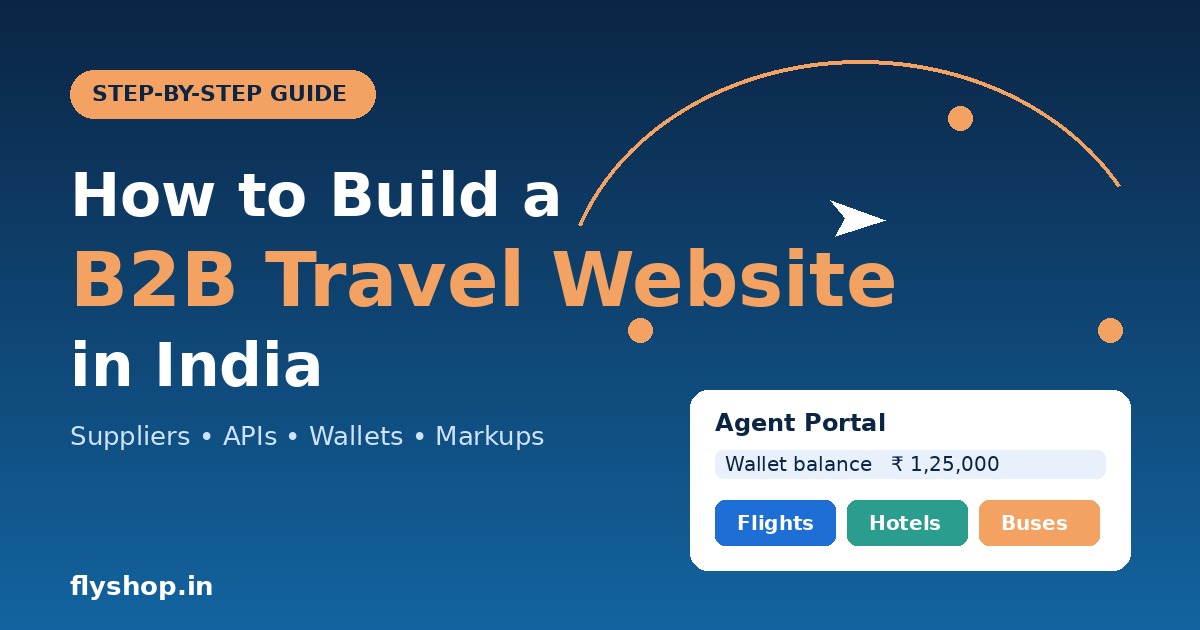
To build a B2B travel website, register your business, sign supplier contracts, choose between custom development and a white label platform, set up agent logins, wallets and markup rules, connect flight, hotel and bus APIs, add secure payments, test every booking flow, and then onboard agents. A white label route is the quickest way to start.
1. What is a B2B travel website?
A B2B travel website is a booking platform where travel agents, sub-agents and partners log in to search and book flights, hotels, buses and holiday packages at rates you control. Unlike a public retail site, agents see their own prices, pay from a wallet or credit line, and earn their own markup. If you want a retail version instead, read about the B2C travel website model.
The money comes from the gap between the supplier's net rate and the price you charge agents. Industry guides describe the same core: a platform that handles net rates, markup rules, agent hierarchy, credit limits and commissions. A strong B2B travel website is therefore less a "website" and more an operating system for a distribution business.
A B2B travel website and a white label travel portal are closely related. The portal is the ready-made software; the website is the branded business you run on top of it. Most new agencies launch the website on a white label portal and add custom work later. See also our guide on how to choose a white label travel portal.
2. Step 1: Choose your model and niche
Decide who you will sell to and what you will sell before you pick any technology. Common B2B models are a wholesaler serving small agents, a consolidator with air inventory, a destination specialist, or a master agent with a sub-agent network. Choosing a niche, such as domestic air plus buses or fixed departures for group tours, lets you build supplier relationships faster than trying to sell everything at once.
- Who are your agents? Small home-based agents need simple tools; larger agencies need reports and invoices.
- Which products first? Start with one or two (for example flights and buses) and add hotels and holidays later.
- How will you earn? Markup on net rates, commission from suppliers, service fees, or a mix.
3. Step 2: Set up the business, GST and licences
Register a legal entity (private limited company, LLP or similar), open a current account and get a GST registration. Travel businesses in India deal with different GST treatment for different services, so get your accountant involved early.
| Service you sell | Commonly stated GST treatment |
|---|---|
| Air ticket booking (agent commission or service fee) | 18% on the commission or fee, with an optional deemed-value method under CGST Rule 32(3) |
| Tour packages | 5% without input tax credit |
| Hotel booking by an agent | Depends on the nature of the supply; confirm with your accountant |
These rates are summarised from public tax guides and can change. Check the official GST portal and confirm with your chartered accountant.
IATA accreditation is not mandatory to start a travel business in India. It becomes useful when you want to issue airline tickets directly through the BSP instead of buying through a consolidator. Review the IATA requirements for India before deciding, because financial security and staffing criteria apply.
4. Step 3: Secure suppliers and API access
Your platform only connects to inventory; it does not create it. You need commercial agreements with airlines, consolidators, hotel suppliers and bus operators, and each one issues you credentials. Start these conversations early because approvals, deposits and certification can take longer than the software itself.
Most B2B portals pull live content through a travel API, so plan your travel API integration around the suppliers you can actually contract. Ask each supplier about rate structure, cancellation rules, API format, test credentials, and what happens when their system is down. For more detail, read our Travel API in India guide.
5. Step 4: Decide how to build it
You have three realistic routes. The right one depends on budget, technical team and speed.
| Route | Best for | Main advantage | Main drawback |
|---|---|---|---|
| Custom development | Large firms with unique workflows and a technical team | Full control of code and features | Highest cost and longest timeline; you maintain every supplier adapter |
| White label platform | Agencies and entrepreneurs who want to launch quickly under their own brand | Ready modules, your logo and domain, supplier APIs already connected | Features follow the provider's product; deep changes may cost extra |
| Hybrid | Growing businesses | Launch on a platform, then build special features | Needs a provider that allows customisation |
Ask any provider for a live demo of the agent login, wallet top-up and markup screen before you sign. If they only show the public homepage, you have not seen the B2B part.
6. Step 5: Plan the must-have features
A working B2B travel website needs more than search and book. Use this checklist when you compare vendors or brief developers.
- Agent registration and login with approval, agent codes and profiles.
- Wallet and top-up (online through a payment gateway, plus offline requests you review).
- Markup management by product, supplier or agent group.
- Flight, hotel, bus and holiday modules with real-time search and booking.
- Booking management including cancellations, refunds, invoices and transaction history.
- Enquiry and callback handling for agents who need help.
- Reports and CRM for leads, customers and follow-ups.
- Admin controls to activate or block agents and monitor sales.
- WhatsApp and email integration for tickets and alerts.
7. Step 6: Design pricing, markup and wallet rules
Pricing is the heart of every B2B travel website you will run. The usual flow is: the supplier's net rate, plus your markup, equals the price the agent pays; the agent adds their own markup to quote the customer. Keep each layer separate so you can see your margin on every booking.
Illustrative example only (not a real fare): if a supplier net rate is ₹10,000 and you add a 3% markup, the agent's cost is ₹10,300. If the agent adds 4% on that, the customer pays about ₹10,712. Your margin is ₹300; the agent's is about ₹412.
Decide how agents pay. A prepaid wallet uses money the agent deposits first. A credit line lets them book up to an agreed limit and settle later. Whichever you choose, make the system block or hold bookings when the balance or limit is reached, so your exposure stays a number you set.
Show agents their available balance, used credit and transaction history in one screen. Most disputes in agent networks come from unclear balances, not from bad intent.
8. Step 7: Add payments and security
Connect a reputable payment gateway for wallet top-ups and direct payments, and keep card data off your own servers by using a gateway that is PCI DSS compliant. Use HTTPS, role-based access, strong passwords with OTP, and regular backups. Because you hold customer and agent data, review your obligations under India's Digital Personal Data Protection Act, 2023 with a lawyer and publish clear privacy and refund policies.
9. Step 8: Test and launch
Run through every booking path before agents see your B2B travel website. A short launch checklist:
- Search, book, cancel and refund one booking in every module.
- Check that wallet debits, credits and invoices match to the rupee.
- Test markup rules for at least two agent groups.
- Test failure cases: supplier timeout, payment failure, duplicate booking.
- Check mobile screens, since many agents book from phones.
- Add basic SEO: titles, meta descriptions, a sitemap and fast-loading pages.
- Prepare an agent onboarding guide and a support contact.
10. Step 9: Onboard agents and grow
Your B2B travel website is only useful when agents use it. Start with a small group of agents you already know, collect feedback, and fix friction before a wider push. Offer simple onboarding, quick approval, and visible support. Later add sub-agent levels, special fares and holiday or group products to give agents reasons to return daily.
11. Common mistakes to avoid
- Building a website instead of a platform. A brochure site cannot manage wallets, markups and agent hierarchy.
- Choosing software before suppliers. Without supplier contracts, the portal has nothing to sell.
- Mixing net rates and sell rates. Keep layers separate so margins stay visible.
- Ignoring cash flow. Credit given to agents can strain your own supplier payments.
- Skipping testing for failures. Real bookings fail in odd ways; test them first.
- No support plan. Agents leave quickly when a booking issue goes unanswered.
12. When you should not build one
Be honest about fit. If you sell only to individual travellers, a retail site is the better start. If you have no supplier contracts and no agent network yet, begin by signing suppliers and recruiting agents before you spend on technology. And if you have a very small team, a full custom build will probably cost more time than it earns.
13. How Flyshop helps you launch a B2B travel website
Flyshop is a Delhi-based travel technology company operating since 2013. Its B2B agent portal includes agent login, flight, hotel and bus APIs, wallet and top-up management, markup management, booking and enquiry management, and invoice access. It runs on your own brand, logo and domain as part of a white label travel portal. See the full list on the features page.
Plans shown on the Flyshop plans section at the time of writing list yearly maintenance of ₹14,999 for the White Label Advance plan (B2B) and ₹19,999 for the Complete White Label plan (B2B and B2C). The Advance plan lists a dedicated sub-agent login, wallet top-up with transaction history and a full CRM. Setup requirements are not listed, so contact the team for current pricing. Available services depend on the suppliers connected to your account.
14. Frequently asked questions
1. How long does it take to build a B2B travel website?
It depends on the route you pick. A white label platform is generally much faster than custom development because modules and supplier connections already exist. Your own timeline also depends on supplier approvals and testing, so ask your provider for a written schedule rather than relying on general estimates.
2. How much does it cost to build a B2B travel website in India?
Costs vary with features, number of supplier integrations and whether you build custom or use a white label plan. Custom projects usually cost far more than platform plans. Ask vendors for a breakdown covering setup, yearly maintenance, API charges and support, and compare plans on the Flyshop plans section.
3. Do I need IATA accreditation to run a B2B travel website?
No. IATA accreditation is not mandatory to start a travel business in India. It helps if you want to issue airline tickets directly and access the BSP. Many agencies begin by buying inventory through consolidators or APIs and apply for accreditation later as volumes grow.
4. Can I build a B2B travel website without coding?
Yes. A white label provider supplies the software, hosting and updates, so your B2B travel website needs no code from you; you configure branding, markups and agents through an admin panel instead of writing code. You will still need to handle supplier agreements, pricing rules, payments and agent support yourself.
5. What is the difference between a B2B and a B2C travel website?
A B2B travel website serves agents who log in, pay from wallets or credit and add their own markup. A B2C site serves end travellers with public prices and direct payment. Some businesses run both from one platform, as in a combined B2B and B2C setup.
6. How do wallets and credit limits work on a B2B travel website?
An agent either tops up a prepaid wallet or books against an approved credit limit. Each booking deducts from the balance or limit, and the system should stop or hold bookings when funds run out. This keeps your risk limited to amounts you have set for each agent.
7. Which APIs does a B2B travel website need?
Most start with flight, hotel and bus APIs, then add holidays, cabs and visa services. The right set depends on which suppliers you sign, and available services depend on the connected suppliers and API configuration. Our guide to travel API integration explains how connections, testing and pricing work.
See the agent login, wallet and markup screens in action. Book a free demo, message us on WhatsApp at +91 92185 01850, or write to support@flyshop.in.
This article is general information for travel businesses and is not tax, legal or financial advice. Confirm GST, licensing and data-protection requirements with a qualified professional.