Case Study: How Meera, a Travel Agent from Pune, Plans for a Stronger 2027 with Flyshop.in
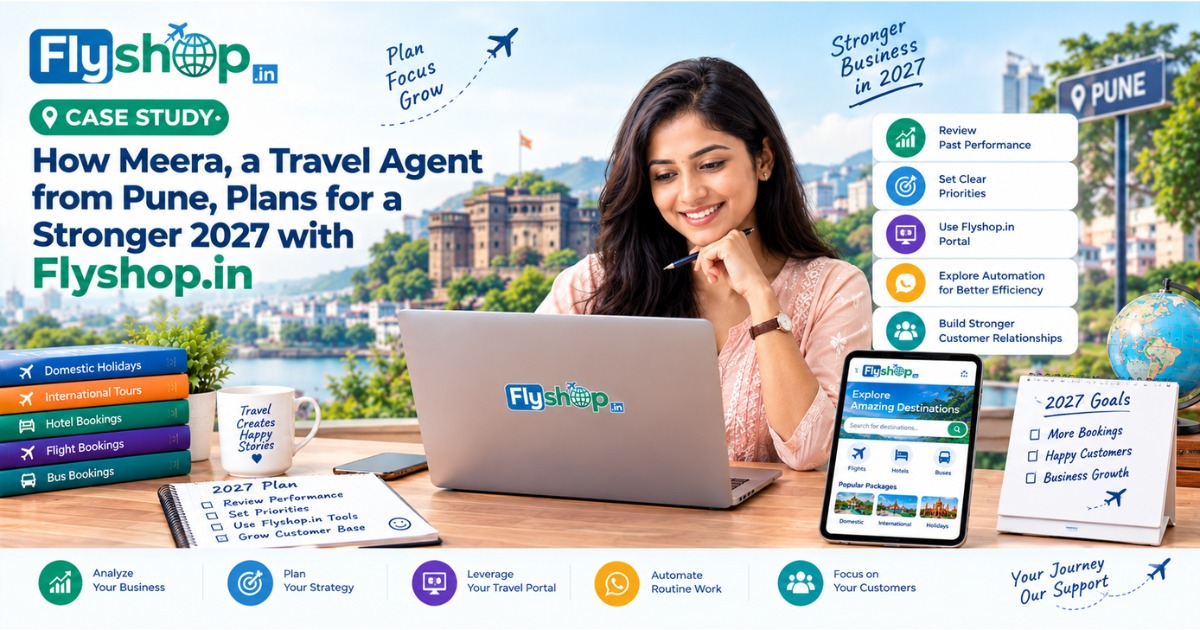
Meet Meera, a Travel Agent from Pune
As the year comes to an end, travel agents have an opportunity to look beyond their day-to-day activities and think about the future of their businesses. Reviewing past performance, understanding customer behaviour, and planning marketing activities can help them identify where to focus their efforts in the coming year.
Meet Meera, a travel agent from Pune who wants to make 2027 a more organized and productive year for her business. Throughout the year, she has worked on managing customer enquiries, promoting travel services, assisting travellers, and handling bookings. Now, she wants to step back and understand which activities deserve more attention.
Meera knows that simply increasing advertising budgets or trying new marketing techniques will not necessarily lead to better results. She needs to understand what has worked, where opportunities exist, and how she can use her time and resources more effectively.
She decides to review her business activities, identify areas for improvement, set realistic priorities, explore the tools available through her Flyshop.in setup, and build a practical action plan for 2027.
Her goal is not to change everything overnight. Instead, she wants to create a clear direction for the new year and take consistent steps towards improving her travel business.
The Challenge: Planning Growth Without Losing Focus
Running a travel agency involves several interconnected activities. Travel agents need to attract potential customers, answer enquiries, share relevant travel options, manage bookings, and maintain relationships with previous customers.
When these responsibilities compete for attention, it can become difficult to decide which activity deserves priority.
For example, Meera may receive enquiries through her website and social media advertisements while also communicating with previous customers. She might want to improve her online visibility, generate more relevant enquiries, or create a more organized follow-up process.
However, trying to improve every area simultaneously could spread her time and resources too thin.
Meera identifies three important questions she needs to answer:
- What worked during the previous year? She needs to review available information instead of relying entirely on memory.
- Where are the biggest opportunities? She wants to identify areas where a practical improvement could make a meaningful difference.
- What should she prioritize in 2027? She needs a manageable plan that fits her business goals and available resources.
With these questions in mind, Meera begins preparing for the new year.
Step 1: Review the Year and Understand Business Performance
Meera starts by reviewing the information available from her business activities over the past year.
Rather than looking only at total enquiries or bookings, she examines several areas that can provide a more complete picture of her business.
First, she reviews customer enquiries. She considers how many enquiries came through different channels, which services generated interest, and whether the enquiries matched the travel options she offered.
Next, she reviews available booking information. Where reliable records exist, she looks at which enquiries progressed into bookings and which conversations did not move forward.
She also considers her marketing activity. This includes reviewing available information about website traffic, advertising performance, and customer responses to different promotions.
Finally, Meera looks at repeat customers. Previous customers may provide opportunities for future bookings, particularly when their travel interests and communication preferences are understood.
The purpose is not to assume that every activity can be evaluated using the same metric. Website visits, enquiries, qualified prospects, and confirmed bookings represent different stages of the customer journey.
By reviewing these indicators separately, Meera can begin identifying patterns.
For instance, a campaign may attract considerable attention but generate few relevant enquiries. Another channel may generate fewer enquiries but connect her with travellers who are more likely to proceed.
The key lesson: Before deciding what to change, understand your starting point. Reviewing available business information can help travel agents make decisions based on evidence rather than assumptions.
Step 2: Identify Opportunities for Improvement
After reviewing her performance information, Meera identifies areas where her business process could be improved.
She does not assume that every challenge requires a new tool or a larger marketing budget. Sometimes, a clearer message, better-organized customer information, or a more consistent follow-up process may be a useful starting point.
She examines three possible areas.
Improving Website Promotion
Meera considers whether potential customers can easily discover her travel business online and understand the services she offers.
She reviews how her branded travel portal is being promoted and whether her marketing messages direct interested travellers towards relevant information.
If customers are clicking advertisements but not enquiring, she can investigate whether the offer is clear and whether the next step on her website is easy to understand.
Improving Advertising
Meera reviews whether her advertising activities have clear objectives and whether she can reliably connect campaigns with relevant enquiries.
She considers focusing on specific services rather than promoting too many unrelated offers at once. This could make campaign performance easier to evaluate.
Improving Customer Follow-Ups
Meera also examines how she communicates with interested customers after their first enquiry.
Some travellers need additional information before deciding to book. If follow-ups are inconsistent or conversations are difficult to track, she may benefit from a more structured process.
By identifying these opportunities, Meera develops a clearer understanding of what deserves attention.
The key lesson: Improvement begins with identifying the actual problem. Choose changes that address a specific business need instead of adopting new tactics simply because they are available.
Step 3: Set Clear and Realistic Priorities for 2027
Once Meera understands the areas that may need attention, she decides which goals should come first.
She knows that attempting to improve her website, redesign every advertisement, introduce multiple automation workflows, and change her entire customer communication process at the same time could make progress difficult to measure.
Instead, she chooses a small number of priorities.
Her first priority is to make her online promotion more focused. She wants each campaign to communicate a clear offer and direct customers towards an appropriate enquiry or booking channel.
Her second priority is to improve the way she manages customer enquiries. She wants to understand which enquiries require immediate attention, which customers need additional information, and where follow-ups are appropriate.
Her third priority is to review performance regularly. Rather than waiting until the end of the year to assess progress, she plans to evaluate important indicators throughout the year.
Meera also considers how to make these goals measurable. Depending on the information available, she may track relevant enquiries, enquiry-to-booking progression, campaign costs, or repeat bookings.
She avoids setting targets without a reliable starting point. First, she establishes what she can currently measure, then she decides what level of improvement is realistic.
The key lesson: A few clear priorities are often easier to execute and evaluate than a long list of ambitious plans. Focus creates room for consistent action.
Step 4: Review How Flyshop.in Tools Can Support Her Goals
With her priorities established, Meera reviews how her branded Flyshop.in portal and available features could support her plans for 2027.
She begins with her online presence. Her branded travel portal can provide a dedicated destination where customers explore the services and booking or enquiry options available through her setup.
Meera considers how to make better use of this portal in her marketing activities. For example, advertisements promoting a particular travel service should direct customers towards relevant information rather than leaving them uncertain about the next step.
She also explores available automation features that may support appropriate routine activities.
Depending on the tools and configuration available, automation may help organize aspects of customer communication or follow-up workflows. Meera considers where these capabilities could address the repetitive tasks she identified during her review.
However, she does not assume that technology alone will improve business performance. Her website still needs clear information, her advertising needs a relevant offer, and customer communication needs to remain useful.
She evaluates each feature according to a simple question: does it support one of her defined business priorities?
This helps her avoid adding unnecessary complexity to her workflow.
The key lesson: Choose tools based on your goals. A branded portal and suitable automation features are most useful when they support a clearly defined business process.
Step 5: Build an Action Plan and Schedule Regular Reviews
Meera now turns her priorities into an actionable plan for 2027.
She divides her goals into smaller activities that can be completed and reviewed over time.
For website promotion, she plans to review the information presented on her portal and make sure her campaigns direct visitors to relevant pages.
For advertising, she schedules focused promotions around suitable services and reviews the available performance information after each campaign.
For customer communication, she plans to organize enquiry records and establish a consistent approach to following up with interested travellers.
She also schedules regular performance reviews. During these reviews, she can examine whether her activities are progressing towards their intended goals and identify any adjustments that may be necessary.
For example, if a campaign attracts clicks but few relevant enquiries, she can review the offer and messaging. If enquiries are relevant but customers are not progressing towards bookings, she can investigate the information provided, follow-up process, and other possible barriers.
Meera understands that a plan should remain flexible. Customer demand, seasonal opportunities, supplier availability, and market conditions may change throughout the year.
The purpose of planning is to provide direction, not to prevent her from adapting when new information becomes available.
The key lesson: Consistent execution and regular reviews turn annual goals into practical business activities.
The Outcome: A Clearer Direction for 2027
By reviewing her business performance, identifying opportunities, setting priorities, evaluating available tools, and scheduling regular reviews, Meera develops a more organized approach to planning the new year.
Her plan focuses on three practical outcomes:
- Clearer priorities: She knows which areas of her business deserve attention first.
- More purposeful use of tools: Her branded portal and available automation features are evaluated against specific business needs.
- Consistent performance reviews: She has a process for learning from campaign activity, enquiries, and booking information throughout the year.
This gives Meera a clearer framework for making business decisions in 2027. Actual improvements in enquiries, bookings, or revenue will depend on execution, customer demand, and the effectiveness of the activities she chooses.
What Other Travel Agents Can Learn from Meera
Meera's approach offers five useful lessons for travel agents preparing for a new year.
Review before you plan. Use available information to understand your business performance and identify meaningful patterns.
Find the biggest improvement opportunity. Focus on the areas that are most relevant to your current challenges.
Set realistic goals. Choose measurable priorities that fit your time, budget, and resources.
Use technology with a purpose. Evaluate your website and available automation features according to the problems they can help address.
Review progress regularly. Use consistent performance reviews to identify what is working and where changes may be needed.
Conclusion: Make 2027 a Year of Focused Progress
For a travel agent like Meera, preparing for a stronger year begins with understanding the current business, identifying opportunities, and deciding where to focus next.
Rather than changing everything at once, she develops a practical plan around website promotion, advertising, customer communication, and regular performance reviews.
With clear priorities and consistent action, travel agents can approach the new year with a better understanding of their goals and the steps needed to pursue them.
Want to plan your next steps with Flyshop.in?
Review your business activities, identify your biggest opportunities, and explore how your branded travel portal and available tools can support your goals.
Reply 2027 PLAN to learn more.