India Simplifies Its Visa Framework: Categories Reduced from 13 to 9, Application Requirements Cut by Up to 70%
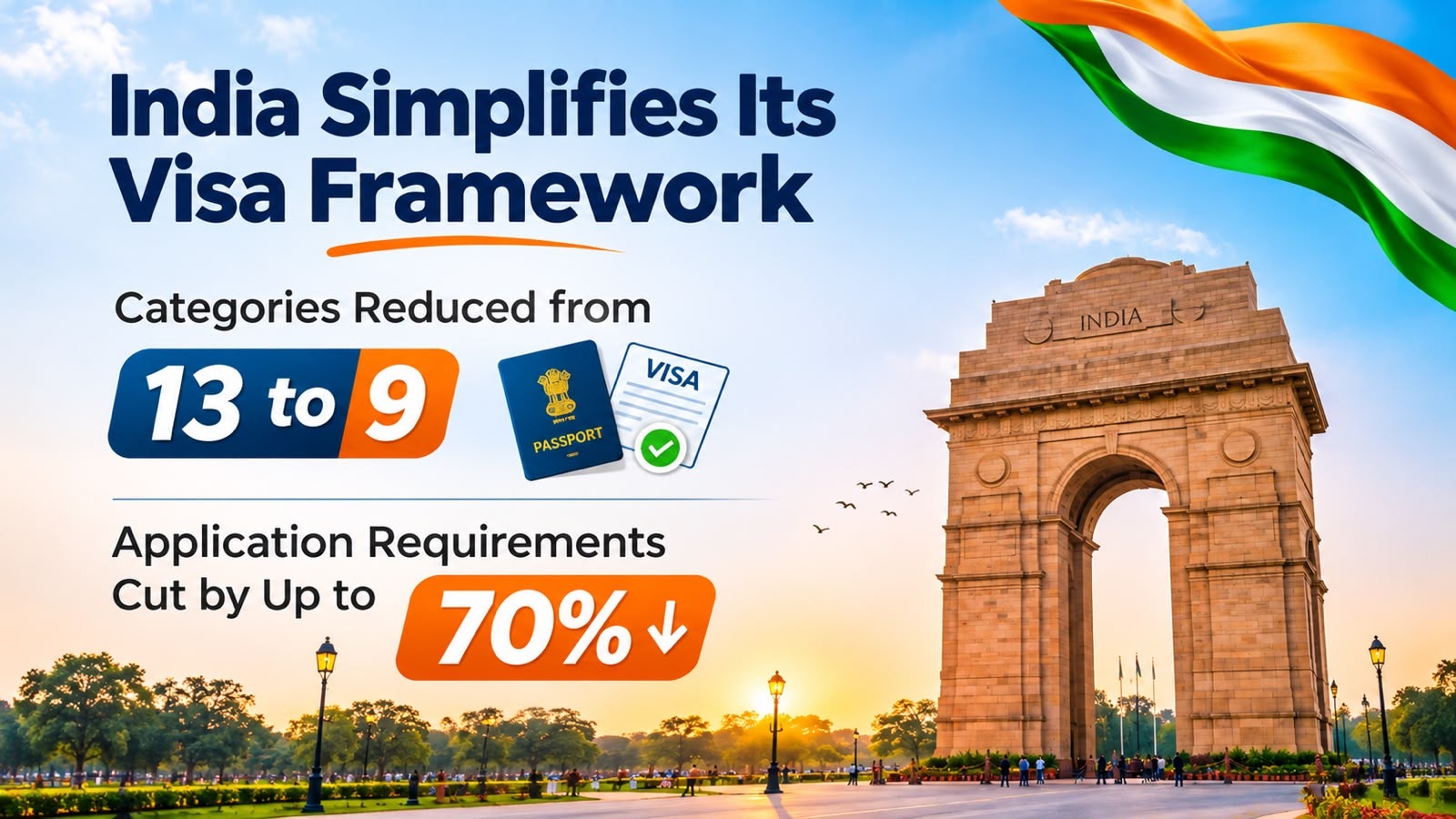
The Government of India has rationalised its visa framework, reducing the number of visa categories, simplifying application forms and reorganising provisions for tourism, medical treatment, education and business travel.
India's Ministry of Home Affairs (MHA) has announced significant changes to the country's visa framework to simplify the visa application process for foreign nationals.
According to a Press Information Bureau (PIB) announcement dated 11 November 2026, the rationalisation was undertaken on 27 August 2026. The changes aim to reduce overlapping visa provisions, improve clarity and make it easier for international visitors to identify the appropriate visa category.
Under the revised framework, the number of main visa categories has been reduced from 13 to 9, while sub-categories have been reduced from 49 to 23. Additionally, the number of fields required in visa application forms has been reduced by approximately 65–70% across all 23 sub-categories.
1. Major Changes in India's Visa Framework
The revised visa framework introduces the following changes:
- Main Visa Categories: Reduced from 13 to 9.
- Visa Sub-Categories: Reduced from 49 to 23.
- Application Form Fields: Reduced by approximately 65–70%.
- Tourist Visa: Renamed as Visitor Visa.
- Visitor Visa: Divided into two sub-categories, V-1 and V-2.
- Medical Visa: Reorganised to cover conventional and AYUSH treatments.
- Student Visa: Consolidated into two sub-categories.
- Business Visa: Restructured into B-1 and B-2 categories.
- E-Visa: Existing provisions are being aligned with the revised framework.
The nine main visa categories are Business, Diplomatic, Work, Journalist, Medical, Official, Student, Visitor and Miscellaneous.
2. Tourist Visa Renamed as Visitor Visa: Introduction of V-1 and V-2
One of the key changes is the renaming of the Tourist Visa as the Visitor Visa. The revised category covers a wider range of short-term activities beyond tourism.
It has been divided into two sub-categories:
V-1 Visitor Visa – Short-Term Visits
The V-1 category provides a 30-day multiple-entry visa for eligible activities, including:
- Tourism and leisure travel.
- Short-term business meetings.
- Medical consultations.
- Wellness retreats.
- Short-duration medical treatment.
- Short courses in Indian languages, music, art and craft.
V-2 Visitor Visa – Longer-Duration Visits
The V-2 category provides longer-duration visitor visa options with validity of:
- 1 year.
- 5 years.
- 10 years.
The applicable validity depends on eligibility and relevant conditions.
The V-2 category also covers mountaineering activities, for which a six-month multiple-entry visa provision is specified.
3. Medical Visa Reforms: Conventional and AYUSH Treatment
The revised framework reorganises medical-related visas into four sub-categories:
- M-1: Medical treatment other than AYUSH-based treatment.
- M-2: Medical attendants accompanying M-1 visa holders.
- M-3: Medical treatment under AYUSH systems.
- M-4: Medical attendants accompanying M-3 visa holders.
M-1 and M-3 visas, including their electronic variants, will ordinarily be granted for one year with multiple entries.
The revised provisions are intended to facilitate international patients travelling to India for medical treatment, including conventional healthcare and traditional AYUSH systems.
4. Student Visa Reforms: Revised S-1 and S-2 Categories
The Student Visa framework has been consolidated into two sub-categories.
- S-1: Covers school, undergraduate and postgraduate education, along with specified studies in Indian languages, Yoga, Vedic culture, music, dance and Indian knowledge systems.
- S-2: Covers PhD and research scholars, visiting faculty, research students, scientific and anthropological expeditions, internships and student exchange programmes.
Foreign students enrolled in eligible Indian institutions through the Study in India portal may receive multiple-entry e-S1 visas for up to five years or the duration of their academic course, whichever is shorter.
These changes aim to simplify visa provisions for international students and academic visitors.
5. Business Visa Reforms: New B-1 and B-2 Categories
The Business Visa framework has been reorganised into two main sub-categories.
B-1 Business Visa
This category covers long-term, licence-based business activities, including establishing industrial or business ventures in India.
B-2 Business Visa
This category covers short-term, contract-based activities, including:
- Production Investment Business.
- Participation in conferences.
- Sports-related activities.
- Performing arts and cultural activities.
- Film production and related activities.
The revised framework also provides for foreign specialists, engineers and technical personnel engaged by Indian companies for specified activities, including installation, commissioning, maintenance, quality checks, training and technology transfer.
Eligible specialists may obtain a Production Investment Business Visa under B-2 through the e-Visa platform. This provision replaces the earlier e-B4 visa nomenclature.
6. Visa Application Forms Simplified by 65–70%
Another significant change concerns the information required from foreign nationals during the visa application process.
The Ministry of Home Affairs has undertaken an exercise to simplify application forms across all 23 visa sub-categories.
The number of required fields and columns has been reduced by approximately 65–70%.
According to the government, the objective is to:
- Reduce the information applicants need to provide.
- Simplify the application process.
- Reduce the time and effort required to complete forms.
- Retain essential information required for visa processing.
- Improve administrative efficiency and facilitate focused scrutiny.
7. E-Visa Availability and Implementation Timeline
India's existing e-Visa facility is available to nationals of 172 countries and is currently processed through electronic travel authorisation under 13 sub-categories.
The Ministry of Home Affairs is updating its IT systems to implement the revised visa categories and application requirements.
According to the government announcement, visas under the new rationalised framework are expected to be granted by the end of 2026.
Until the updated system is implemented, foreign nationals should check the applicable visa category, eligibility requirements and application procedures through official government channels.
8. What Are the Nine Main Visa Categories?
Under the revised framework, India's visa regime will consist of the following nine main categories:
- Business Visa: For business activities, investments, conferences and specified commercial engagements.
- Diplomatic Visa: For diplomats and eligible dependents.
- Work Visa: For foreign nationals undertaking eligible long-term employment and specified activities in India.
- Journalist Visa: For eligible journalists.
- Medical Visa: For foreign nationals seeking medical treatment, including AYUSH treatment, and their attendants.
- Official Visa: For eligible non-diplomatic officials and their dependents.
- Student Visa: For education, research, internships and academic exchange programmes.
- Visitor Visa: For tourism and other permitted short-term activities, including business meetings and medical consultations.
- Miscellaneous Visa: For specified categories, including persons of Indian origin, eligible dependents and other purposes not covered by the remaining categories.
9. Key Takeaways
India's revised visa framework represents an important administrative change in the country's immigration and travel regulations.
The reduction in visa categories, simplified application forms and restructuring of provisions for visitors, medical patients, students and business professionals are intended to make the visa system more accessible and easier to navigate.
However, the revised framework will be implemented through updated government IT systems, with the new visa issuance process expected to begin by the end of 2026.
Foreign nationals planning to travel to India should verify the latest visa regulations, eligibility criteria and application requirements through official government sources.
Official Source: Press Information Bureau (PIB), Ministry of Home Affairs, Government of India – 11 November 2026.